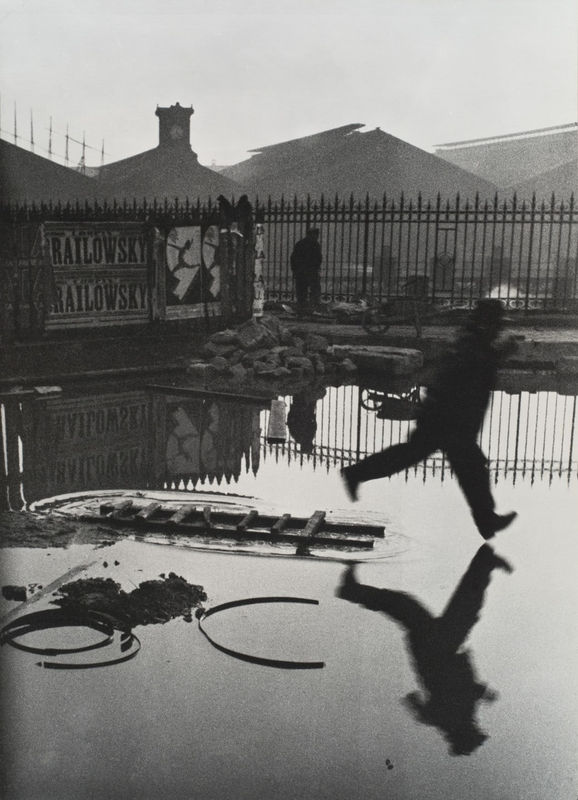
‘Shooting a picture is holding your breath as all your faculties focus on capturing fleeting reality; then taking a picture becomes a moment of great physical and intellectual delight.It is a matter of putting your brain, your eye and your heart in the same line of sight. It is a way of life.’
Henri Cartier-Bresson was born in France in 1908. He trained as an artist before beginning his photographic career in the early 1930s, spending time on the Ivory Coast, in Europe, Mexico & the USA. In 1940 he was captured by the Nazis and spent three years in prisoner-of-war camps before escaping to join the Paris resistance. From 1944-45 he took a series of portraits of writers and artists for Editions Braun, including Matisse, Braque, Bonnard, Claudel and Rouault.
In 1946 he spent over a year working in the USA on the so-called "posthumous" exhibition of his work, proposed by the Museum of Modern Art in New York when he was believed to have died during the war. In 1947 Cartier-Bresson founded the co-operative photographic agency Magnum, along with Robert Capa, David Seymour (Chim) , William Vandivert & George Rodger.
He then travelled all over the world capturing not just news, but unique moments in our history. Cartier-Bresson’s first book, Images à la sauvette, with a cover by Matisse, was published in France in 1952 by Tèriade. This was also published in New York under the title The Decisive Moment.
1954 marked the beginning of a long collaboration with Robert Delpire with the publication of Les Danses à Bali. In this year he was also the first photographer to be allowed into the USSR during the period of dètente. In 1955 Tèriade published Les Européens, with a cover by Mirö, and in 1958-59 Cartier-Bresson returned to China for three months for the tenth anniversary of the People’s Republic of China.1963-66 Cartier-Bresson travelled throughout Mexico, Cuba, Japan and India. It was in 1966 that he terminated his active working relationship with Magnum Photos, although the agency distribution retains his archives.
Cartier-Bresson continued to travel and photograph until 1975 when he decided to concentrate on drawing. Exhibitions of his photographic work have maintained his presence in galleries & museums worldwide, and he has been celebrated with awards and prizes and numerous birthday celebrations. In 2000 he made plans with his wife Martine Franck & daughter Mélanie, to set up the Fondation Cartier-Bresson, to provide a permanent home for his collected works as well as an exhibition space open to the other artists. The foundation won state-approved status in 2001, and was opened in the spring of 2003.
The photographs of Henri Cartier-Bresson were first exhibited at the Julien Levy Gallery, New York, in 1933. His first museum show was at the Museum of Modern Art New York, in 1947. Since then he has been continually exhibited in major galleries, museums and institutions around the world.